
A Silence Observed: Christian Contemplation and the Gift of the Present Moment

" Even if daily life is as difficult as it can be, God nevertheless remains present in each one of us. He is a patient, faithful, and merciful God who waits untiringly....the journey toward heaven consists of rediscovering our silent interior life in which God dwells and waits for us, watching the horizon."
- Robert Cardinal Sarah, from The Power of Silence

If you'd like future reflections delivered straight to your inbox—grounded in faith, inspired by classical wisdom, and informed by evidence-based psychology—subscribe here
“Take nothing with you, especially any expectations. Also, bring your Bible. Maybe a notebook.” This was the reply I got from a dear friend and colleague when I asked him how best to prepare for my first extended silent retreat. As a fellow ACT clinician, a long-time student of contemplative practice, and a really good friend, he knew exactly where my mind would go.
I tried my best to follow his advice. My Bible and notebook were packed but my mind was whirling with ever changing narratives. I was going to a place I’d never been, away from my wife and kids for the longest I’d ever been, spending time alone with nothing but my thoughts – and God.
I once heard Father Rocky on Relevant Radio say each of us has the opportunity to write our own Gospel, the Good News of God working in our lives. In behavioral science, we often speak of conducting experiments and reporting outcomes. When done with one participant, we call these case studies. This post is perhaps a little of both.
Despite my best efforts, I went up to the mountain with many expectations. None of them were met.
And that’s exactly where He met me.
Carrying My Luggage Up the Mountain

New Camaldoli Hermitage is indescribably beautiful. It is roughly 12 miles from the nearest town (population 14) and deep within Big Sur, perhaps the last remote area of coastal California. It’s so remote, the one lane road that serves traffic both ways, is closed much of the year due to landslides.
Off the main road, a quarter mile worth of switchbacks leads you up to the hermitage where, depending on when you arrive, you pick up your welcome packet and the key to your cell from the small store. They are only open a few hours a day, so outside of that time they leave the key for you in a small box outside.
Leaving later than planned, the expected five-and-a-half-hour drive invariably turned into seven-and-a-half. Consequently, I found myself rushing and worried that I would be “late.”
Late for a silent, solo retreat whose only objective was being present with God.
Despite my friend’s advice I was carrying a lot of luggage up the mountain. One piece I discovered: I still thought I was supposed to be doing something rather than being with Someone.
The Weight of Silence
Another thing I expected when I arrived was to be met with some discomfort or boredom. I was not prepared for what actually happened.
When I arrived, turned off my car, and entered my cell I heard the silence. Wind in the leaves, birds chirping, the creak of the floorboards as I walked to the old desk and set down my backpack. I was suddenly hit by a tidal wave of emotion. Like the swells of the Pacific Ocean outside my window, rising, falling and marching ever onward, my own emotions surged.
Joy. Gratitude. Sadness. Longing.
On the desk, was a welcome packet with the opening lines of the Brief Rule of St. Romuald, the founder of the Camaldolese Order:
“Sit in your cell as in paradise. Put the whole world behind you and forget it. Watch your thoughts like a good fisherman watching for fish. The path you must follow is in the Psalms—never leave it. If you have just come to the monastery, and in spite of your good will you cannot accomplish what you want, take every opportunity you can to sing the Psalms in your heart and to understand them with your mind.”
In silence, I learned how much I – someone who regularly engages in Christian contemplation and helps people navigate their own busy minds – was still caught up in “doing”. When the doing slipped away, I felt strangely bare and uncertain.
So, I followed the Psalms.
I noticed Psalms of joy. Psalms of gratitude. Psalms of sadness. Psalms of longing. Within the Psalms indeed there was a path.
Intellectually I knew this well enough. But to encounter it deeply in solitude was something entirely different. What the Psalms did was give words to the very feelings I was experiencing. Feelings that were not meant to disappear before I approached God, but feelings I was being invited to offer up like incense to Him.
Rhythms of Christian Contemplation

I said earlier there was nothing to do. But that doesn’t mean I was not active. That’s another thing that surprised me.
The day had structure, sounded out by the beautiful church bells. There was Lauds in the morning, Mass during the day, and Vespers and Adoration at night. There were also meals at set times laid out in the small community kitchen.
In between, as St. Romuald suggested, I would read the Psalms. Sometimes in my cell. Sometimes on the balcony overlooking the Pacific Ocean below me.
Sometimes I’d walk and pray my rosary. Often, I’d just sit, notice, and listen.
Within this rhythm something emerged. Moments took on more significance. The first look at the ocean in the morning. The wildflowers I’d pass along my walks. The cup of tea at night reflecting on a particular passage that stirred me.
I was astounded how although I was in solitude I never once felt alone. In engaging, even so fleetingly, in the monastic life, I noticed how coming together for communal prayer like Mass and Vespers, filled me with a sense of connection. But so too, in a very special way, did the quiet. It was like a highlighter over the key words in the sentences that make up ordinary life.
One particular series of events stands out. There was a young woman I’d see on nearly every walk and at every meal. We’d smile, nod and give a quick “prayer hands” to each other. A word was never spoken between us. Yet, here we were.
I knew nothing about this woman, and somehow cared for her like a sister. I could tell she cared for me too. Yes, there were no words, but each of us knew the other was silently praying in charity. Praying that in the absence of words the other would resoundingly hear the only Word that matters.
We were two travelers walking the same path of solitude and finding a paradox: true solitude does not lead to isolation, but profound communion.
Really and truly, nothing out of the ordinary happened my entire time there. That’s what made it all the more extraordinary. In between ordinary moments, I was also reminded how much silence can reveal.
Standing Before the Emperor
The second half of the Brief Rule of St. Romuald is as follows:
“And if your mind wanders as you read, do not give up; hurry back and apply your mind to the words once more. Realize above all that you are in God’s presence, and stand there with the attitude of one who stands before the emperor. Empty yourself completely and sit waiting, content with the grace of God, like the chick who tastes nothing and eats nothing but what his mother brings him.”
My mind wandered A LOT while in silence. Anything and everything passed through it:
Things to do and things to remember.
Memories and images.
Worries and anxieties.
Judgements and evaluations.
Of the latter, I was very much surprised. Not that I had them, but how poignant the words of St Romuald were.
An example to illustrate. The chapel at New Camaldoli is a very special place. The altar is in the center of a large, octagonal chamber where, during both the Consecration at Mass and at Adoration, all are invited to enter and circle around the altar. It is a profoundly intimate experience.
One night at Adoration, I recall resting in God’s presence. There were maybe seven or eight other people. I was filled with a deep sense of gratitude and connection. After about fifteen minutes I heard the entrance door loudly creak and footsteps echo across the silent church.
I saw two young men enter. As each footstep resounded, my mind thundered:
“Come on, I was just experiencing something!”
“Who is that?”
“How could they be so rude?”
“How disruptive of them, don’t they know Who’s here?”
“Kids these days!”
“Could they not try to be punctual?”
In an instant, my gaze shifted from the Blessed Sacrament before me to the whirling stories inside me. I was caught up in narratives my mind had drawn up about these two young men I knew nothing about. My mind, being what it is, was all to happy too fill in the gaps.
It was only after they walked past me (and knelt right beside me) that I understood how true St Romuald’s words were:
Realize above all that you are in God’s presence, and stand there with the attitude of one who stands before the emperor.
Here I was, invited to sit with the Emperor, and I was concerned about the other guests in attendance. Without fail, self-criticism showed up on the heels of that realization. But here my mind was again turning toward yet another story, and away from the Greatest Story Ever Told sitting silently before me.
And if your mind wanders as you read, do not give up; hurry back and apply your mind to the words once more.
The Emperor, the Word made Flesh, was still there, patiently waiting. The One who lovingly waits for each of us every moment was waiting for me in that moment. Was I willing to turn back and wait with Him?
I thanked God for these two young men.
Coming Home: Finding God in the Present Moment
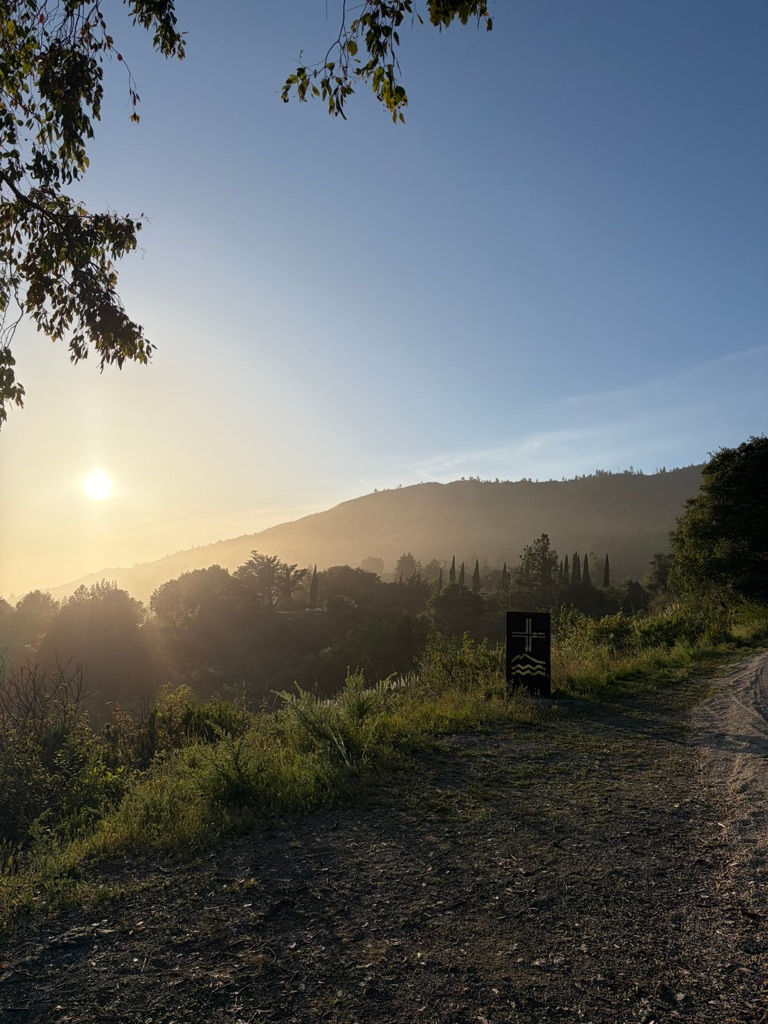
My final Mass at New Camaldoli was bittersweet. I was excited to go home and see my family. I was grateful for the time in silence with my Creator. As I stepped into my car, I was taking away a deeper love and a keener awareness of His presence.
Then I came home.
Like dew in the scorching sun, that felt sense of peace swiftly evaporated amidst dirty diapers, crying kids, emails, patient scheduling, presentations, chores, and the thousand other tasks that make up daily life.
That little machine between my ears started whizzing again with thoughts like:
“So much for that retreat!”
“You had peace on the mountain, you couldn’t carry it with you.”
“Did you really think a few days away would change things?”
I realized, not only did I carry luggage up the mountain I carried plenty back with me. An expectation that somehow life would be different. That I would be different. Perhaps, in some way, I thought I would be transformed into a monk.
But I’m not.
St. Therese of Lisieux once wrote, “It appears to me that humility is the truth. I know not whether I am humble, but I know that I see the truth in all things.” The truth? I was never meant to stay in silence. I’m a husband and a father. I’m a friend and a parishioner. I’m a clinician and a veteran. I’m a lot of things to a lot of people.
Most of all, I am a sinner in need of a Savior.
I went up the mountain hoping to escape the noise. In that sense, I failed miserably. But my failure was a happy fault because what I experienced was far more precious than how to temporarily escape busyness.
What the mountain taught me was not how to flee from ordinary life, but how to return to it. One day, God willing I’ll return to the New Camaldoli. I know He’ll be there waiting. But the Emperor who was waiting for me there in the silence is here right now, waiting for me in the whirlwind.
He is always waiting for me.
For Further Reflection:
This section contains Amazon affiliate links. If you click and make a purchase, I may earn a small commission at no cost to you. These small earnings help fund the mission of the Take Courage Resilience Center and keep the lights on. Thank you for your support.
Books
Robert Cardinal Sarah, The Power of Silence
Jacques Philippe, Searching for and Maintaining Peace
Jean-Pierre de Caussade, The Sacrament of the Present Moment
Retreat and Spiritual Direction
Related Reflections
Don't Believe Everything You Think: Choosing Meaning Over Mental Chatter
Anchored In Him: A Christian Practice for Anxiety, Anger, and Overwhelm
Feeling Good vs Living Well: The Desire For Happiness and the Home We Were Made For
How to Calm the Nervous System: 6 Ways to Quiet the Temple of the Holy Spirit


