
Carrying the Things They Carried: Meaning, Moral Injury, and the Veteran’s Burden

Updated: Sep 5
“They carried all they could bear, and then some, including a silent awe for the things they carried.” - Tim O’Brien

This post contains Amazon affiliate links. If you click and make a purchase, I may earn a small commission at no cost to you. These small earnings help fund the mission of the Take Courage Resilience Center and keep the lights on. Thank you for your support.
If this resonates, you're welcome to subscribe here for future reflections on meaning, resilience and faith.
I remember as a young boy, going to visit the traveling Vietnam Veterans War Memorial, The Wall That Heals. The Wall, like its original, has etched upon it the names of over 50,000 American service members who were killed in Vietnam.
It’s one of those memories that stay with you.
There I saw grown men silently approach the wall, touch an etched name and bow their heads. Some had families standing quietly behind them, watching and waiting, unsure what to do but knowing they were witnessing something sacred. Others had an arm around a brother or fellow comrade. Some wept. Others looked on, their eyes fixed on scenes lost to the mists of time.
A few were the mothers, wives, brothers, sisters and children of the fallen. They looked at the names of their relatives and no doubt were filled with memories of a life cut short by war.
Still others, stood at the wall alone. No family, no comrades nearby. They stood like silent statues outside a sepulcher, carrying with them the weight of memory.
All of them, in fact, carried a great deal of things –questions, guilt, sadness, love and loss. Stuck somewhere between a longing for what was and yearning for what could have been.
In his novel, The Things They Carried O’Brien reveals what I witnessed at the wall, the weight veterans carry, in a way that only prose can. We’re going to look into the rucksack of the veteran who comes home from war and what it looks like to carry that rucksack. We'll also look at the healing journey - how modern psychology can aide us and faith can be a guide.
For a deeper look at what that homecoming journey often entails, I’ve explored this more fully in my series on The Warrior’s Return, where we examine what it means to come back - not just physically - but psychologically and spiritually.
The Things They Carried in War and After
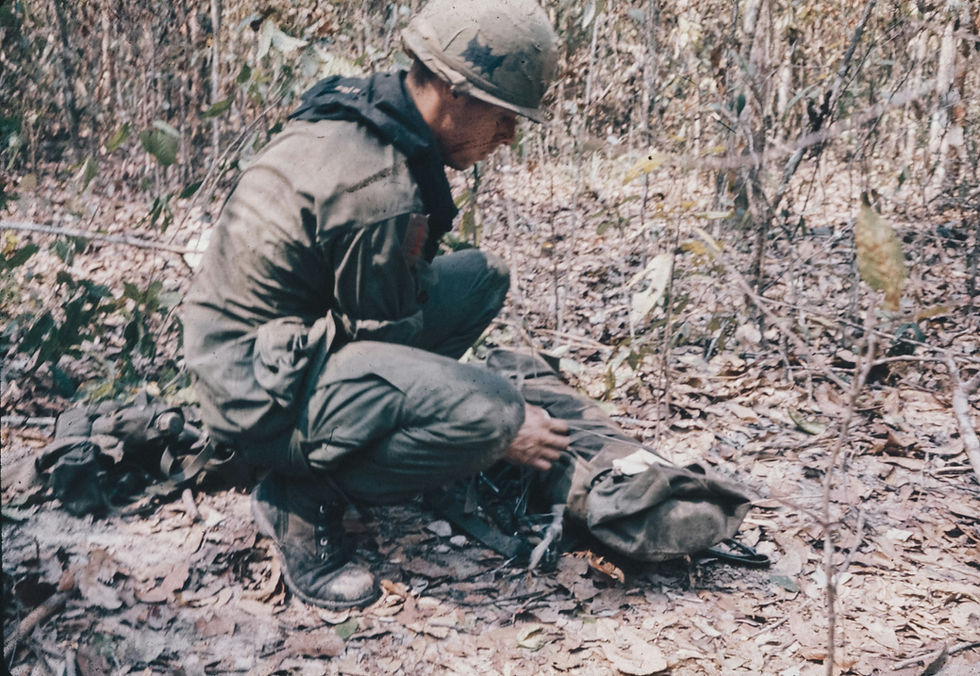
In The Things They Carried, readers follow the life of an Army infantry platoon in Vietnam and post-Vietnam. The novel itself is an interconnected series of short stories. Like a jungle patrol, the plot weaves through the past and present, and blurs the line between fact and fiction. Each vignette, in its own way highlights that not all the burdens of war are seen. In fact, the heaviest often are invisible.
At the start of the novel, O’Brien lists the many physical things soldiers carry– weapons and equipment like rifles, grenades, ammunition, medical supplies, food, communication equipment, body armor, uniforms, etc.
The reader also gets a glimpse of the various trinkets and personal items, many carried out of necessity, superstition, or comfort, but generally a mix of all three. All of which add to the weight.
But more than any of that, they carried, “all the emotional baggage of men who might die...grief, terror, love, longing....the intangibles had their own mass and specific gravity, they had tangible weight.”
They carried reputations and fear of losing face in front of their brothers. Sometimes they even carried each other: the wounded, the ill, the dead and the dying. They shared blood and tears, and the “shared weight of memory.”
Lt. Jimmy Cross, the 24- year old platoon commander, along with his weapons, personal equipment and their maps and orders, carried love letters from a girl back home. And, when at the outset of the novel, when one of his men, Ted Lavendar, is killed, “he felt shame. He hated himself...and this was now something he would have to carry like a stone in his stomach for the rest of the war.”
Only, he doesn’t carry it for just the rest of the war. Like the men of his platoon, and like all soldiers, there are some things you carry for the rest of your life.
The Weight Veterans Carry: Trauma, the Nervous System, and Moral Injury

I’ve sat with many men who have carried a heavy ruck long after their war ended. Not just the memories—though those come, often uninvited—but something heavier. A quiet inventory of burdens accumulated over time.
There is the weight of what they saw. The weight of what they did. The weight of what they couldn’t do.
There is grief. For brothers lost, for innocence gone, for a version of themselves that no longer exists.
There is guilt that doesn’t always make sense on paper. The kind that lingers not because it is rational, but because it is human. The “if only” that replays in the background. The question of whether they could have done more, been more, saved more.
There is anger. Sometimes sharp and outward, sometimes buried and turned inward. Anger at leadership, at the war, at the world, at God.
There is also something quieter. A sense of disconnection. From others. From meaning. From the person they were before everything changed.
And often, beneath it all, there is shame. Not always spoken, rarely named directly, but present. A sense that something has been broken, or lost, or stained beyond repair.
Part of this burden is not just psychological—it is physiological. The nervous system, shaped by repeated exposure to danger, learns to scan, to react, to stay ready. Heightened awareness, quick anger, restless sleep. These are not signs of weakness. They are adaptations. They are the very responses that kept men alive when the stakes were life and death.
But what once protected can become difficult to carry when the war is over. The body does not always receive the memo that it is safe. The vigilance remains. The edge stays sharp.
And so many do what they have always done. They push forward. They hold it together. They bury it as best they can. Sometimes through work. Sometimes through alcohol or distraction. Sometimes through isolation.
And then there is another kind of weight. Harder to name. Harder to speak. What psychiatrist Jonathan Shay described as a “wound of the soul.” When a person does something—or fails to prevent something—that violates their deepest moral framework, something deeper than fear is touched. This is not simply trauma in the nervous system. It is a fracture in meaning. A rupture in how one understands oneself, others, and the world.
This is moral injury. And unlike physical wounds, or even many psychological ones, it does not heal simply with time. It lingers in questions. In silence. In the quiet conviction that something essential has been lost.
These are not items you can simply set down. They are carried. Like O’Brien writes, not just as physical weight, but as emotional, psychological, and spiritual burden. These are stories, memories, questions, and wounds that do not neatly resolve.
And yet, what I have seen again and again is this: What is carried does not have to crush us.
Carrying the Ruck: Acceptance and Learning How to Carry What We Carry

I’ve heard many Veterans reflect on the things they carry. Whether it’s the psychological and spiritual wounds of war itself, or the after effects. It becomes like a rucksack. So often, in an effort to drive away the pain we add more to the ruck.
Understandably, veterans want the ruck gone. They hate that they carry the things they carry. But that desire is itself a weight.
At other times they say, “I have to carry this. It’s my fault and I don’t want to put it on anyone else.” And that too, is more weight.
Sometimes they are afraid to see what’s in the ruck. And so they avoid anything that brings them close to looking inside. Or try to forget the things they carry. But, memory has no “delete” button. That impossible search is just more weight.
In Acceptance and Commitment Therapy often the first step is facing the fact that yes, you have a ruck to carry and it may always be there. In fact, trying to remove it often is the problem. It only adds weight. Acknowledging the things we carry is carry is called acceptance.
Many people struggle with that word. They think acceptance is the same as condoning or even worse welcoming. It is the furthest thing from these extremes.
Acceptance means staring at the monster under the bed. It is recognizing reality for what it is, and noticing how we respond—fear, anger, guilt.
Then, it goes further. In recognizing the cost of getting swept up in a struggle to remove something that cannot be removed. To win in a fight that can never be won. At least, not in the sense of making it disappear. That is acceptance.
The other part of acceptance is choosing how we carry the things we carry. When guilt shows up do we let it push us further into isolation? Or allow it to be present and move toward what matters? In that way,
That journey must start by looking into the ruck - by naming the things we carry.
Once we do, we can learn to change our relationship to them. We can learn to redistribute the weight. To adjust how we carry it. We can learn to recognize when we are adding more to our pack. And ultimately, we can learn to carry our packs - yes even the heavy ones - to the places that matter.
We can learn to be led by our values like love, duty, service, friendship, family, rather than have the ruck dictate where we go. We can walk with travelers on the road, those we have chosen and those who have chosen us, and keep pace even when the weight says “turn back. Not today.”
Ultimately, wecan learn to choose not just how but to where we carry our rucks.
It’s not easy. Fortunately, we were never meant to carry it alone. Like the disciples on the road to Emmaus, who walked in sorrow without recognizing the One beside them, we too can walk with the One who walked with them.
Radical Responsibility: What Dostoevsky and Stoicism Teach About Meaning

In The Brothers Karamazov, Dostoevsky advances a vision that stands in stark contrast to the isolation so many of us—veteran and non-veteran alike—carry. He writes, “Each of us is responsible for all, for all mankind and for each individual man.” This is not merely poetic. It is a description of reality.
The sins we commit ripple outward in ways we cannot fully see or measure. As Dostoevsky suggests elsewhere, “Touch one part of the ocean, and it is felt on all shores.” Nothing we do exists in isolation. In the story of the three brothers and the brokenness of their father, we see how one man’s disorder spreads, shaping generations.
This is what the Russian tradition calls sobornost: a deep, spiritual interconnectedness. A shared participation in one another’s lives, for good or for ill. Not radical individualism, but radical communion. All lives bound together – whether we acknowledge it or not.
Veterans, perhaps more than most, are acutely aware of this reality.
Many are haunted not only by what they endured, but by the lives they took—even in self-defense. Because they know what it means to “touch the ocean.” They know that somewhere, a child may never know his father. A mother may never again see her son. The ripples are real, and they carry them.
As one line attributed to Fr. Zosima’s brother captures, “Everyone is really responsible to all men for all men and for everything.”
And so they carry more than their own burden. They take on, in a sense, the weight of a fractured world. A world that fails to resolve conflict peacefully and sends young men and women into its consequences.
But this is often where they become stuck.
They see the ripples of the past, but not always the ripples of the present. They see where they have touched the ocean, but not how they are still touching it now.
Here the Stoics offer a necessary corrective. Marcus Aurelius once wrote, “You could leave life right now. Let that determine what you do and say and think.” Elsewhere, he reminds us that whether we live a thousand years or ten thousand, the only life we ever lose is the one we are living now.
The Stoics remind us that the only life we ever truly possess is this one – this living moment. And each moment places a question before us. How will you respond?
Viktor Frankl understood this deeply. He wrote that life is not something we ask meaning from, it is instead asking something of us. And our task is to respond. To be responsible for how we carry what we carry and responsible for where we carry our ruck to today. In other words, we respond by being “response-able”, capable of answering for what life asks of us today.
This is the turning point.
Because as Dostoevsky insists, responsibility does not end with guilt—it begins there. “There is only one means of salvation,” he writes, “and that is to make yourself responsible for all men’s sins.”
At first glance, this sounds unbearable. But rightly understood, it is not a crushing burden. It is a path forward. Because just as sin ripples outward, so does love. Each moment becomes an opportunity to enter into that same interconnected reality. Not by withdrawing in shame or isolation, but by choosing to act, to love, to repair.
To carry the weight differently.
Ultimately, we do not escape the fact that we have touched the ocean. We move forward by accepting that we are still touching it.
And under that weight there is both responsibility—and hope.
The Ruck and the Cross: Carrying Suffering with Meaning and Purpose

Fortunately we have a model to follow. St. Paul said, “Therefore just as one man’s trespass led to condemnation for all, so one man’s act of righteousness leads to justification and life for all.” (Romans 5:18). Death and sin were brought about by Adam’s choice at the Fall. Salvation was brought about by Our Lord’s choice at Calvary. Where Adam rejected his responsibilities, to God, to his wife, and to himself, Christ took on the responsibility of all of us.
Every follower of Christ is called to be a reflection of him – a living example of His love. Christ makes this explicit when He says, “I have set you an example that you should do as I have done for you” (John 13:15). In this way, whatever ruck we carry becomes our cross to bear.
To be clear, this is not the weight of blame that keeps us stuck. This is the choice to bear responsibility now. One is inward-focused, trying to remove or solve the pain. The other is outward-focused—carrying the burden and still moving toward others. One is a self-sacrifice that punishes the self. The other is a sacrifice of self for others.
There is no easy way for this shift to happen. It begins with a simple but difficult step: recognizing the things we carry. And then, choosing how we carry it and to where we carry it.
The ruck does not disappear. But in time, it can become something else.
Not just a burden, but a cross. And not just a cross — but a path.


